

Clearer standards are needed for electric scooters and all “rideables”.Council passed motion asking the feds to introduce stronger regulations and enforcement.
Between 2020 and 2024, St. Michael’s Hospital reported a 240 per cent spike in annual electric bike-related hospitalizations. For e-scooters injuries the increase was 600 per cent.
Electric scooters and other “rideables” are popping up everywhere in Toronto.
They appear on three wheels, two wheels, and, sometimes, one wheel, as with the unicycle. But, however they present, they are quicker, quieter, and, as such, a potentially deadly addition to our mobility options.
Downtown, in well-travelled bike lanes, they jostle with traditional pedal-powered bicycles, sometimes jumping onto sidewalks to the terror of pedestrians. In the suburbs, they scoot along with ease – a cheap option for young people opting not to wait for a bus that may be slow in coming because it is stuck in traffic.
A segment of car drivers and pedestrians argue that they should be banned because of the danger they pose to their users and to people on the go.
Conversely, there is a strong argument for their retention. They have no emissions and, as such, are a help in reducing climate change. They help cut congestion by taking cars off the road; and they are an affordable way to get around, especially for delivery workers supporting our local businesses.
But the rules have not kept up with this fast-growing technology, making enforcement challenging and safety a growing concern. That is why I called on the federal and provincial governments to set clearer standards so everyone can move around safely.
Council passed my motion asking the federal government to “introduce stronger regulations and enforcement addressing public safety risks posed by unregulated and uncertified electric micromobility devices; this may include new or enhanced regulations under the Consumer Product Safety Act, Canada Transportation Act, and Motor Vehicle Safety Act.”
Council also supported my motion directing staff to “formally request the Ministry of Transportation to update the definition of power-assisted bicycles under the highway traffic act to reflect the evolving range of micromobility devices currently on the market.”
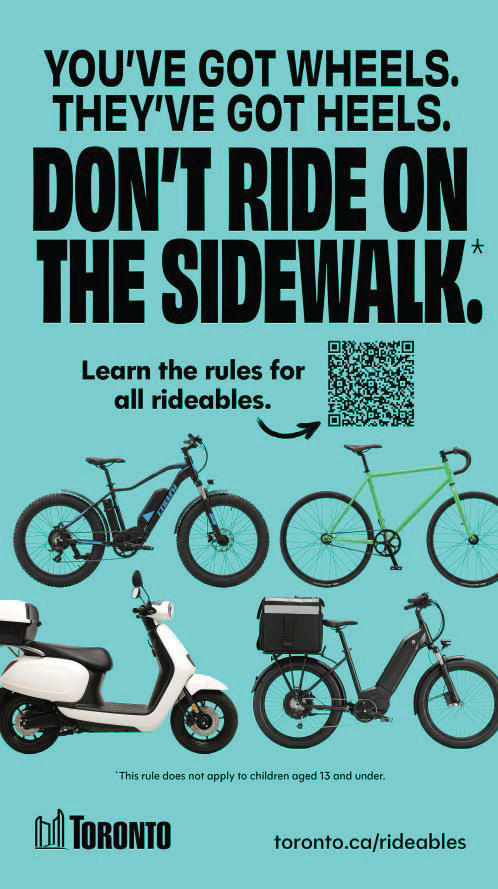
Electric scooters, unicycles and electric skateboards are illegal in Toronto – on sidewalks, in bike lanes, on the street and on trails – everywhere except on private property. But you wouldn’t know by watching the proliferation of these and other e-mobility devices powered by battery or a force other than pedal power.
City Council considered a micromobility update at its October meeting – an exercise that captured the frustration of trying to manage, regulate and enforce rules around a mode of transportation that is gaining popularity in spite of confusion over what is allowed, where and how.
Meanwhile, evidence grows concerning the danger of these “rideables.” Between 2020 and 2024, St. Michael’s Hospital reported a 240 per cent spike in annual electric bike-related hospitalizations. For e-scooters injuries the increase was 600 per cent.
Meanwhile, police cannot seize e-scooters because they can be legally sold and operated on private property. (Press reports say most e-bikes are brought in from Asia or assembled in Canada with imported parts.)
Reduction in the popularity of these modes of transportation is unlikely to happen any time soon. It’s incumbent of the federal, provincial and city government to coordinate a strategy to deliver safe operation of what are now being called the “rideables.” And it starts with providing clear and enforceable rules.