
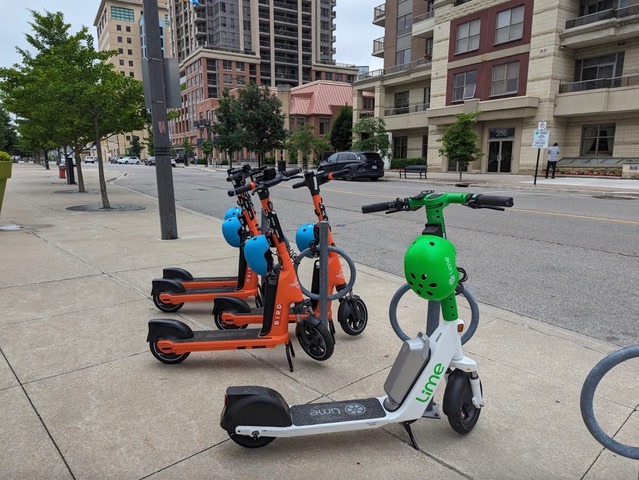
Mayor Carolyn Parrish says e-scooter riders “drive like lunatics”. Council looks at Mississauga’s e-scooter program report, wants to see rules followed.
E-scooters are everywhere these days in Mississauga and while City staff is supportive of the batter-powered micro-mobility devices, the Mayor and some councillors have concerns.
Mayor Carolyn Parrish said she’s “not a big fan of this program” and is fed up with the people who “drive like lunatics,” saying, “they give me the heebie-jeebies every time they go flying by.”
“Since 2021 there have been 13 liability claims against the city caused by privately owned e-scooters, versus 3 caused by the city’s mobility program e-scooters”
In December 2025, city staff presented council with an update on the city’s shared mobility program. In 2024 Mississauga launched the e-bike and e-scooter program with corporate partners Bird Canada and Lime Canada.
For the program, 300 e-bikes and 900 e-scooters were placed throughout Mississauga, along with 100 micro-mobility parking stations. The rentable bikes have top speeds of 32km/hr and the scooters can go 24km/hr. Riders must be at least 16 years of age, wear a helmet and stick to city streets under 50km/hr or go on bike lines and cycling paths.
But according to some councillors and the Mayor, compliance with the rules, both on the corporate owned machines and private ones as well, is not good enough. They are putting people’s safety at risk and frustrating pedestrians and other road users.
Councillor Stephen Dasko called the shared mobility program “challenging at best” and questioned the parking rules in his ward after receiving complaints from residents.
The city report noted the parking compliance rate was 98.3% during inspections. Anecdotal evidence cited by the Mayor and some councillors, however, suggest that e-scooters can be found lying around the city, often damaged and abandoned, with the companies responsible failing to pick them up.
According to the city, in 2025, ridership and compliance within the shared mobility program were up and complaints and inquiries were down.
Privately owned e-scooters, on the other hand – which are allowed under a provincial pilot program – generated more problems. Privately owned e-scooters, which can reach much greater speeds than the city’s rentable versions, and which are frequently used by kids and teens, generated 13 liability claims against the city versus 3 for the shared mobility program since 2021.
In response to pleas from city council last year for better enforcement, Lime Canada and Bird Canada did hand out more fines and account suspensions this year.
When it comes to privately owned e-scooters, the city relies on education campaigns to improve compliance.
This year the city partnered with school boards to educate kids and teens about the rules around e-scooters underage riding. The Peel District School Board has also banned e-scooters from being used or parked on its property.
The contract for the shared mobility program expires after 2026, with the option for the city to renew for another 2 years.
The e-scooter provincial pilot program was extended until 2029. The City of Toronto, which did not opt in to the pilot program, does not allow e-scooters of any kind within its borders.
HAVE YOUR SAY? YOUR VOICE MATTERS!
What should happen with e-scooters in Mississauga? Are they a good alternative mode of transportation? Or are they more trouble than their worth? Let us know at info@mpulse.ca